
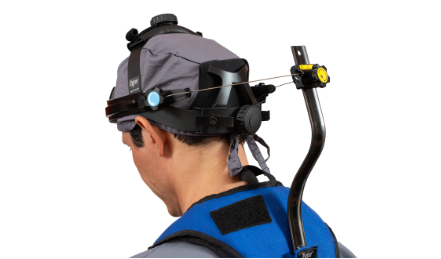
Surgeons who rely on head-mounted lighting systems often work through long procedures that require sustained focus, precision, and stable positioning. While headlights are essential for visibility in many surgical specialties, they introduce an additional physical load that is frequently overlooked during equipment evaluation.
Over time, even relatively small amounts of added weight on the head can increase strain in the neck, shoulders, and upper back. This is especially relevant during extended procedures in which the cervical spine remains fixed for prolonged periods. Many surgeons begin to notice subtle fatigue during longer cases, which can accumulate across surgical schedules and contribute to discomfort by the end of the day.
The challenge is not removing headlights from surgical practice. They are critical tools in maintaining visibility and precision. The challenge is managing the physical impact they introduce so surgeons can maintain comfort and stability without altering their workflow or surgical technique.
This is where ergonomic support strategies become important. By helping redistribute physical load and encouraging more neutral postural alignment during procedures, surgeons can reduce perceived strain while continuing to operate within their standard workflow.
Request a clinical evaluation to see how cervical load support performs during headlight-assisted surgical procedures in your environment. This gives your team a practical way to assess comfort, posture stability, and workflow fit during real cases before moving into broader adoption.
Headlights are widely used in surgical environments because they provide direct, controlled illumination in deep or complex procedural fields. However, when mounted on the head, they introduce a forward or downward load that the cervical spine must continuously counterbalance.
Even lightweight systems can create sustained tension in the neck muscles during long procedures. This is often amplified by:
In surgical environments, this means that even small ergonomic inefficiencies can accumulate over time, affecting comfort and endurance across procedures.
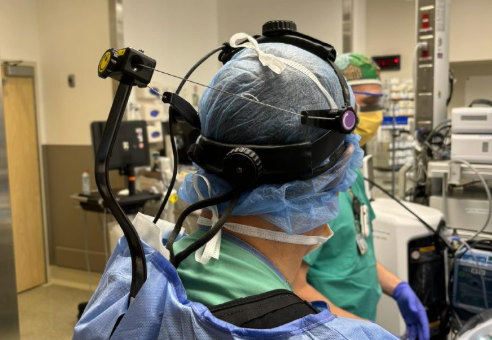
Cervical strain typically does not present with an immediate limitation. Instead, it builds gradually throughout procedures and surgical days.
Surgeons may experience:
While these effects do not necessarily impact surgical capability, they can influence comfort, endurance, and long-term physical sustainability.
Over time, unmanaged strain can contribute to decreased procedural comfort, particularly in high-volume surgical schedules where recovery time between cases is limited.
A key objective in ergonomic surgical support is maintaining a more neutral cervical posture while preserving the surgeon’s ability to work precisely and efficiently. Neutral posture reduces unnecessary muscular activation in the neck and upper back, allowing the body to maintain stability with less fatigue.
Ergonomic support systems designed for procedural environments aim to assist by:
Rather than changing how surgeons operate, the goal is to reduce the physical burden associated with maintaining visibility and precision over time.
One of the most important considerations in surgical environments is ensuring that any ergonomic support does not interfere with procedural flow. Surgeons rely on consistent positioning, predictable instrument access, and uninterrupted focus during operations.
Effective ergonomic systems are designed to integrate into existing workflows without requiring changes to:
This allows surgeons to maintain full control of their workflow while benefiting from improved physical support throughout the procedure.
NekSpine’s approach focuses on supporting natural movement and posture during procedures that require head-mounted equipment, helping reduce strain without introducing operational complexity.
When head-mounted systems are used for extended periods, the cervical spine compensates for the additional load by increasing muscular activation in the neck and upper back. Ergonomic support systems can help counterbalance this effect by improving overall postural alignment and reducing the sustained effort required to maintain head position.
This does not eliminate the weight of the equipment, but it helps the body manage that load more efficiently throughout the procedure. The result is often improved comfort and reduced perceived fatigue, especially during longer surgical
cases.
When cervical load is better supported, surgeons frequently report:
These outcomes are particularly relevant in high-volume surgical environments where cumulative strain can affect long-term physical sustainability.
NekSpine develops ergonomic support systems specifically designed for procedural environments where clinicians experience sustained cervical loading from equipment such as headlights and loupes. Their systems are intended to help redistribute physical strain and support a more neutral posture without interfering with surgical workflow or technique.
In surgical settings where head-mounted lighting is essential, this type of support allows clinicians to maintain operational efficiency while reducing cumulative physical stress over time.
External ergonomic guidance, such as NIOSH research on occupational musculoskeletal strain, reinforces the importance of managing sustained static loads in precision work environments.
Head-mounted surgical lighting is essential for procedural accuracy, but it introduces a physical demand that accumulates over time. When cervical load is not addressed, even subtle strain can impact comfort and endurance across surgical schedules.
By supporting a more neutral posture and helping redistribute physical load, ergonomic systems can improve long-term comfort while preserving the surgeon’s natural workflow and procedural precision.
Schedule a fitting to evaluate how ergonomic support can improve comfort during headlight-assisted surgical procedures. This allows your team to assess posture, load distribution, and workflow integration within your actual clinical environment.