

Microsurgery requires exceptional visual focus, precision, and physical stability. Surgeons working under microscopes often maintain a highly controlled posture for extended periods while performing intricate procedures in which even slight movement can compromise accuracy.
The challenge is not excessive movement, but the absence of it. Microscope-based procedures frequently require clinicians to maintain a fixed visual position for extended periods, with minimal opportunity for natural repositioning. Over time, this leads to a steady accumulation of muscular load throughout the cervical spine, shoulders, and upper back.
Many surgeons do not notice the strain during the procedure itself. Instead, the effects often appear afterward as stiffness, tightness, fatigue, or reduced mobility following long cases or repeated procedures throughout the surgical day.
NekSpine develops ergonomic support solutions designed specifically for procedural environments where sustained cervical positioning is unavoidable. Our systems are designed to support posture during microscope-based procedures while preserving surgical precision, workflow efficiency, and clinician control.
Contact us today to book your trial and try out our headlight and our Pro360 neck support.
Microscope use naturally encourages a forward and fixed head position. Even when posture is optimized at the beginning of a procedure, maintaining consistent visual alignment limits the ability to reposition throughout the case.
This creates continuous muscular activation across the neck and upper back without meaningful recovery periods.
Unlike dynamic movement, which allows muscles to alternate between activation and rest, static positioning keeps the same muscle groups under prolonged tension for the duration of the procedure.
Over time, surgeons may experience:

Research from the National Institute for Occupational Safety and Health (NIOSH) identifies sustained static posture as a significant contributor to musculoskeletal strain in precision-focused work environments where movement variability is limited.
Microsurgical environments often reflect these exact conditions.
The physical demands associated with microscope-based surgery rarely come from a single factor. Instead, strain develops through the accumulation of small, sustained stresses over time.
Microsurgery requires a stable visual axis throughout the procedure. Because even slight deviations can affect visualization, clinicians often maintain the same head and neck position for extended periods.
Aligning with microscope oculars commonly places the cervical spine in a forward posture that increases muscular demand across the neck and upper shoulders.
Long procedures and repeated surgical scheduling reduce recovery time between sustained posture periods, contributing to cumulative physical fatigue.
Individually, these demands may appear manageable. Combined, they can create a consistent pattern of strain that develops gradually throughout a surgical career.
The goal is not to alter surgical positioning or compromise control, but to better accommodate the physical demands of maintaining stable alignment over extended procedures. This helps clinicians stay focused on procedural accuracy while mitigating the cumulative strain of prolonged static posture.
It states on the National Library of Medicine, “When the operating hand and the eyepieces are at the same high level, the wrist tends to be at ulnar deviation, which is increased when the surgeon’s arms are long; consequently, the grip strength is decreased. This means that the surgical microscopes need to be at the right position for surgeons.
Traditional ergonomic recommendations often rely on movement, repositioning, or posture variation. In active microsurgical procedures, those adjustments are rarely practical.
Any solution that interferes with visualization, workflow continuity, or instrument control is not clinically viable.
NekSpine focuses on supporting the body within the realities of microscope-based surgery rather than attempting to change surgical technique.
Our ergonomic support systems are designed to help clinicians maintain required positioning with reduced muscular effort during prolonged procedures.
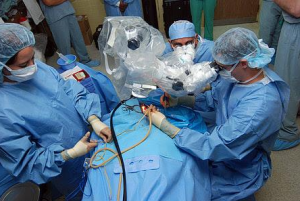
This approach allows surgeons to maintain the stability required for microsurgery while helping reduce the cumulative physical burden associated with prolonged static posture.
In high-precision procedural environments, even subtle reductions in physical strain can become meaningful over time.
Microsurgeons often prioritize procedural accuracy over physical awareness during surgery. As a result, ergonomic improvements may not feel dramatic during a case itself.
Instead, the impact is often noticed afterward through:
Using a microscope at the wrong height and angle requires a hunched position. As a result, strains in the neck, forearms, and eyes are common in prolonged microscope usage.