Pediatric Surgery Ergonomics: The Postural Demands of Operating on Small Patients

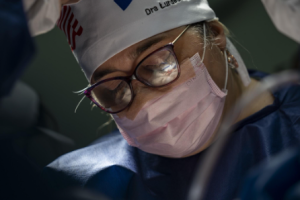
Every operating room is designed around the needs of the patient. In pediatric surgery, those design considerations can create unique ergonomic challenges for the surgeon. The table is often positioned lower to accommodate a smaller patient, while the reduced operative field may require increased forward flexion and magnification to maintain precise visualization. The delicate nature of pediatric procedures, tighter working tolerances, and limited opportunities for repositioning can further increase the physical demands on the surgical team.
Over time, the cervical strain associated with these sustained postures may accumulate across repeated cases and procedures. Many surgeons adapt to these demands as part of their daily practice, sometimes recognizing the impact only after discomfort or fatigue begins to affect their work. If that pattern describes your experience, schedule a free NekSpine demo to evaluate passive cervical support in your specific environment before making any decisions.
The Table Height Mismatch Is More Pronounced in Pediatric Surgery Than in Any Other Specialty
Why the Ergonomic Problem Starts Before the Case Does
In adult surgery, table height adjustments allow the surgeon to approximate a reasonably neutral posture for many case types. In pediatric surgery, and especially in neonatal and infant cases, the operative field is so small and so low that achieving adequate visual access requires the surgeon to sustain forward head flexion at angles that table adjustment alone cannot correct. According to our published clinical research on cervical spine load, a forty-five-degree forward head tilt increases the effective weight the cervical spine carries to approximately forty-nine pounds, compared to ten to twelve pounds in a neutral position.
That load is present for the full duration of the case, and for pediatric surgeons who run multiple cases per day, it accumulates without a reset between cases. The full biomechanical load curve for different flexion angles is detailed on our clinical evidence page, which shows what passive counterbalance produces at those angles during actual surgical procedures.
Neonatal and Infant Cases Represent the Most Extreme Version of This Problem
Small Field, Precise Instruments, No Room to Move
Neonatal surgery can present some of the most demanding postural challenges within pediatric surgical environments due to the precision and positioning requirements involved. The operative field requires the surgeon to sustain the most demanding cervical flexion angle across the longest duration with the least opportunity for positional variation. The instruments are proportionally fine; loupes are typically required for adequate visualization, and the consequences of positional error are greater than in larger cases.
The combination produces a sustained, high-angle, loupe-dependent postural load profile that represents one of the highest cervical exposure scenarios in all of surgery. Passive structural counterbalance addresses this load at whatever angle the neonatal operative field requires, without changing how the surgeon works or the visual access the case demands. More detail on how our system integrates with loupe use is available on our headlight and loupe compatibility page, and you can request a free trial to evaluate fit in your neonatal or pediatric case mix directly.
Pediatric Urologic and Orthopedic Cases Add Loupe Dependence to High Daily Case Volume
Where Repetition Across Multiple Daily Cases Compounds the Load
Pediatric urology and orthopedics share a postural profile defined by loupe-dependent work in small fields across cases that may be individually moderate in duration but collectively add up to significant cervical exposure over daily volume. A pediatric urologist running four to six loupe-dependent cases per day carries a cervical load profile driven by repetition rather than by a single long case, and the total daily exposure can equal or exceed that of a surgeon running one long open case.
Passive support worn continuously across that case volume reduces the cumulative daily exposure in a way that table adjustments, stretch breaks, or postural awareness cannot match, because those interventions do not reduce the load during the case itself. Our clinical evidence page documents the outcomes our published research demonstrates for sustained procedural work, and a demo lets you evaluate the system across your specific daily case volume before making any commitment.
Passive Counterbalance Addresses the Cervical Cost of the Table Height Mismatch

What the System Changes and What It Does Not
Passive cervical support does not resolve the table-height mismatch in pediatric surgery. The table will continue to be set for the patient, and the surgeon will continue to work at the flexion angle the case demands. What changes with passive support is the cervical cost of working in that position.
By counterbalancing the effective head weight at the flexion angle required by the procedure, the system reduces the muscular effort and compressive load the cervical spine carries continuously throughout the case, without changing how the surgeon operates, what equipment they use, or how the operative field is accessed. According to our published clinical research, structural counterbalance produced a 56% increase in static endurance time and a 41.7% reduction in neck and shoulder discomfort at 45 degrees of flexion. Review the full study on our clinical evidence page, and schedule a demo to see what that reduction looks like in your own pediatric cases.
The Operative Field Will Always Be Set for the Patient. The Cervical Cost of Working in It Does Not Have to Stay the Same.
Pediatric surgery will always place the surgeon in a posture defined by the patient’s anatomy rather than by ergonomic optimization. Passive structural support addresses the cervical cost of that position continuously throughout the case, across every case, across the full duration of a career spent in one of surgery’s most demanding postural environments. Schedule a free demo to evaluate the system in your specific pediatric case environment, or review the peer-reviewed research behind passive cervical support on our clinical evidence page.