For Surgeons at Every Career Stage: A Realistic Look at How Postural Load Accumulates, Why It’s Hard to Feel Until It’s Hard to Ignore, and What Practical Prevention Actually Looks Like
Most surgeons do not consider posture-related injury a career-stage issue until they are already experiencing symptoms. But the biomechanical load that eventually produces chronic neck and back pain begins accumulating in residency during the highest-volume, longest-duration, and most ergonomically uncontrolled phase of a surgical career.
Among surgeons and medical interventionalists with work-related musculoskeletal disorders, as many as 12% require a leave of absence, activity restriction or modification, or early retirement. The trajectory between early-career strain and career-limiting injury is not sudden; it is gradual, incremental, and almost entirely preventable when addressed at the right stage.
A realistic prevention lens, grounded in what posture strain actually looks like at each career stage, gives surgeons practical awareness and specific steps that fit real clinical work, without requiring a complete workflow overhaul. The goal is not perfection. It is interrupting the accumulation curve before it becomes irreversible.
Book a Virtual Fitting to evaluate NekSpine® for your specific procedural environment and body type without disrupting your schedule. Our team will walk through fit, compatibility, and what to expect across your caseload before you make any decisions. Book your virtual fitting through the NekSpine® website.
Residency: When Cumulative Load Begins
- Residents perform the highest procedural volumes at the lowest ergonomic support, with high case loads, long hours, and minimal protected time for recovery
- Residents report higher pain levels than attending surgeons, often linked to workload and limited ergonomic training.
- MSK symptoms appearing in training have been documented as early predictors of career-limiting injury in later stages
Early to Mid-Career: The Normalization Phase
- Pain becomes background noise that surgeons accommodate, adjust, and push through rather than address
- Less than one-third of surgeons who have musculoskeletal pain exacerbated by operating seek treatment for their symptoms. Normalization is the dominant cultural response
- Procedural volume peaks at mid-career maximum lifetime exposure, occurring during the least ergonomically supported phase
Late Career: When Load Becomes Limitation
- Accumulated cervical and lumbar wear begins to limit case duration, procedure type, and operative schedule
- The most common reported health problems leading to premature surgeon retirement are musculoskeletal disorders.
- Career modification patterns: reducing case volume, avoiding high-demand procedure types, and early retirement
What “Neutral Support” Means in Practice
- Not eliminating forward head flexion, which, according to this article, is clinically impossible in most procedures
- Reducing the load transferred to cervical musculature at each degree of flexion, across every case, every day
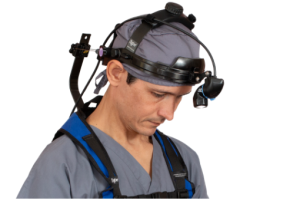
- NekSpine®’s passive counterbalance model acts continuously without requiring behavioral change mid-procedure
The Right Time to Start Is Before It Becomes Necessary
- Intervention is most effective when initiated before symptom severity limits options
- How to evaluate NekSpine® without disrupting current workflow: free demo, virtual fitting, trial program
FAQ
When do MSK symptoms typically begin for surgeons?
Residents report higher pain levels than attending surgeons, often linked to workload and limited ergonomic training, indicating that symptoms begin accumulating during the residency phase, well before symptoms become limiting.
What percentage of surgeons experience career-limiting MSK injury?
Among surgeons and medical interventionalists with work-related musculoskeletal disorders, as many as 12% require a leave of absence, activity restriction or modification, or early retirement.
Why do surgeons commonly delay addressing musculoskeletal symptoms?
Less than one-third of surgeons who have musculoskeletal pain exacerbated by operating seek treatment for their symptoms, a pattern rooted in a normalization culture, time pressure, and the absence of visible structural support options.
Is it too late to benefit from ergonomic support if symptoms are already present?
No. NekSpine® reduces ongoing load accumulation regardless of whether symptoms are already present, slowing progression and reducing daily discomfort even in surgeons with established cervical or lumbar strain.
What are the most common MSK-related reasons surgeons reduce or end their careers?
The most common reported health problems leading to premature surgeon retirement are musculoskeletal disorders with neck, back, and shoulder conditions being the primary contributors.
What does NekSpine® actually change about a surgeon’s intraoperative posture?
NekSpine® does not require the surgeon to change procedural technique or body position. The carbon fiber Support Beam passively counterbalances head weight, reducing the cervical load transferred to musculature at whatever flexion angle the procedure requires, without restricting movement.
Is NekSpine® appropriate for surgical residents?
Yes, and early adoption is the most protective career decision available. NekSpine® offers a medical resident purchase program for those who wish to establish protective ergonomic habits during the highest-load phase of their training.
How does NekSpine® compare to other ergonomic interventions like stretching routines or posture reminders?
Stretching and postural awareness address symptom recovery and behavioral awareness, but do not reduce intraoperative load during the procedure. NekSpine® addresses the structural source of load acting during the procedure, not before or after it.
Review the independent peer-reviewed evidence behind NekSpine®’s clinical effectiveness, published in the Annals of Surgery and Sensors, before your next step. Visit the NekSpine® website to view clinical evidence.