Loupes, Headlights, and Neck Strain: How Head-Mounted Gear Adds Up.
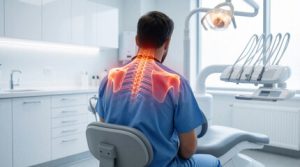
Loupes and headlights let surgeons and dentists see fine detail, so most clinicians who do precise work would not give them up. But everything mounted on the head is weight the neck has to hold, often for hours, and often with the head tipped forward. This post looks at what the research says about head-mounted gear and the neck, and what to consider when you choose your setup.
Looking for support that works with your loupes and headlight?
NekSpine® is designed to work with loupes, headlights, microscopes, and radiation leads.
Why a Forward Head Is So Costly
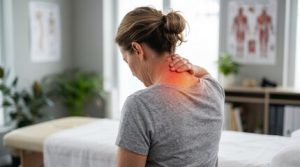
The head is heavy, and the farther it tips forward, the harder the neck muscles have to work to hold it. A widely cited model by spine surgeon Kenneth Hansraj estimated that an adult head weighs about 10 to 12 pounds, but that tilting it forward 15 degrees raises the force on the cervical spine to about 27 pounds, and tilting it 60 degrees raises it to about 60 pounds (NPR, reporting on Hansraj, 2014). Those figures come from a model of posture, not from measurements in the OR. Still, they illustrate how increasing neck flexion may increase estimated cervical loading.
What Researchers Found in the OR
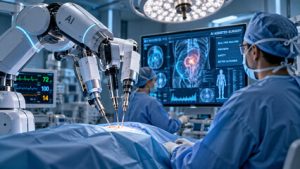
A field study followed microsurgeons as they operated with loupes and a headlamp. Nearly 85% of their operating time was spent with the head and neck bent or rotated more than 15 degrees while also flexed more than 15 degrees. Flexion beyond 45 degrees, and the bending and rotation the surgeons used, produced significantly higher loading on the cervical spine than near-neutral postures. The weight of the loupes and headlamp increased that loading further (Chapman et al., 2013). The study included only three surgeons, so it is best read as a close look at real cases rather than a population estimate.
A four-participant conference abstract from an ongoing study from the same research group compared loupe designs. Loupes reduced how far participants flexed the neck, but they increased side bending and rotation. The researchers saw higher muscle activation with loupes set at a 30-degree telescope angle, though the overall effect of loupe condition on muscle activity was not statistically significant (Chapman et al., 2013, IIE conference proceedings). That study had only four participants, so the findings are preliminary.
What This Means for Your Setup

The research doesn’t say loupes are bad. Loupes can reduce how far you bend your neck. The research suggests that the total system matters: the posture your loupes put you in, and the weight on your head for the length of the case. A few questions to ask:
- How much does the optic weigh? Every ounce on the head is held by the neck for the whole procedure.
- What posture do your loupes put you in? In the studies above, loupe design changed how far surgeons flexed, bent, and rotated the neck. Have your loupes fitted to your own working posture.
- How long are your cases? Load that is easy to hold for 20 minutes is different from load held for several hours.
- Is anything supporting the weight of your head? Loupes and headlights add load, so it’s worth asking what offsets it.
How NekSpine Fits In
NekSpine is a wearable carbon fiber support system that weighs less than 2 lbs. Its support beam is designed to counterbalance the weight of the head, and it is designed to work with loupes, headlights, microscopes, and radiation leads. For clinicians who want a lighter headlight, the Pro360™ LED headlight has a 5 oz optic and can mount to the NekSpine system or be worn on its own head frame.
NekSpine has been evaluated in two peer-reviewed studies. In a lab study of 10 adults performing simulated tasks, it reduced neck and lower back muscle activity by up to 31%. One of the tasks was done at 45 degrees of neck flexion while wearing a headlight (Zindashti et al., Sensors, 2026). In a study of 12 surgeons across six specialties, surgeons reported significantly less neck and shoulder discomfort with the device (Kim et al., Annals of Surgery, 2026). Both studies are small. You can read both on the Clinical Evidence page.
Try NekSpine with your own loupes and headlight.
Book a trial with the NekSpine team.