Neck and Back Pain in Dentistry: What the Research Shows
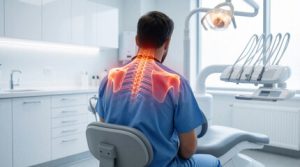
Most of the conversation about clinician ergonomics focuses on the operating room. Dentistry deals with the same problem in a different setting: close, detailed work in a small field, patient after patient. This post summarizes what the research shows about neck and back pain among dental professionals.
Curious about NekSpine for dentistry?
NekSpine® is a lightweight carbon fiber support system designed for surgeons, dentists, and other health care professionals.
How Common Is Pain Among Dental Professionals?
A systematic review and meta-analysis published in PLOS ONE pooled studies of dental professionals in Western countries. It included 41 studies, 30 of which went into the meta-analysis. The pooled 12-month prevalence estimates identified the neck as the most frequently affected region at 58.5%. The lower back followed at 56.4%, then the shoulder at 43.1% and the upper back at 41.1%. (Lietz et al., PLOS ONE, 2018).
The individual studies varied widely, with reported prevalence ranging from 10.8% to 97.9% depending on the study (Lietz et al., 2018). That is a wide spread, so any single study’s number should be read with care. Even so, the pooled figures put neck and lower back pain in the majority of dental professionals studied.
Why the Neck Takes the Load
The head gets heavier for the neck the farther it tips forward. A widely cited model estimated that the force on the cervical spine rises from the head’s weight of about 10 to 12 pounds in a neutral position to about 27 pounds at 15 degrees of forward tilt, and about 60 pounds at 60 degrees (NPR, reporting on Hansraj, 2014). Those are modeled estimates, not measurements of dentists at work. They help explain why a posture held across a full schedule of patients adds up.
Magnification is part of the picture too. In a field study of microsurgeons working with loupes and a headlamp, the weight of that equipment further increased loading on the cervical spine (Nimbarte et al., 2013). That study was in surgeons, not dentists, but the equipment is similar. Read more in Loupes, Headlights, and Neck Strain.
What the Research Does and Does Not Tell Us

The research makes a strong case that neck and back pain are common in dentistry. It is less clear on exactly which factors cause the most harm and which interventions work best, because the results vary so widely between studies. That is a reason to look at ergonomics as a whole system, including chair height, patient positioning, loupes, lighting, and support, and to judge any product on its own design and evidence.
How NekSpine Fits Into a Dental Practice
NekSpine was designed for surgeons, dentists, and other health care professionals who spend long hours in awkward positions. It has three parts: a head frame that conforms to the skull, a carbon fiber support beam designed to counterbalance the weight of the head, and a vest that provides lumbar support. The full system weighs less than 2 lbs and adjusts for torso length, belt length, tension, and padding.
For dental work, two details matter. NekSpine is designed to work in seated positions, and it is designed to work with loupes and headlights. That includes the Pro360™ LED headlight, which has a 5 oz optic.
Two relevant peer-reviewed studies discussed here evaluated NekSpine, one in surgeons during real procedures (Kim et al., Annals of Surgery, 2026) and one in a lab with simulated tasks (Zindashti et al., Sensors, 2026). Neither study focused on dentists. One dentist featured on NekSpine’s Surgeon Insights page, Dr. Kristie Chrispin, DMD, put it this way: “Any healthcare professional who spends hours in awkward positions should consider the NekSpine®.”
Try NekSpine chairside.
Book a trial with the NekSpine team.