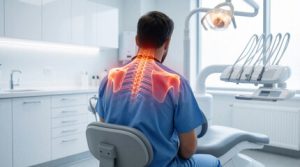
NekSpine vs. Posture Fixes: Why Simple Adjustments Aren’t Enough
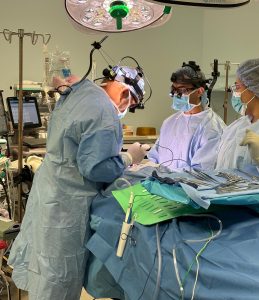
Surgeons and dentists deal with neck and upper back pain at rates far higher than the general working population. The reasons are mechanical: long procedures require sustained forward head posture, which places significant compressive and gravitational load on the cervical spine, and that load does not decrease just because the clinician is aware of it. The standard response has been ergonomic adjustment — set the table correctly, choose the right stool, use loupes with an appropriate declination angle, and take stretch breaks when possible. These interventions are valuable, and the evidence for them is real. But clinicians who follow all of the ergonomic guidelines still experience cervical fatigue, and many still develop cumulative musculoskeletal problems over the course of a career. Understanding why requires looking at what posture adjustments actually do — and what they leave unaddressed.
What Posture Fixes Are Designed to Do
Ergonomic interventions for surgeons and dentists are designed to optimize the angle at which the clinician enters a procedure. An adjustable operating table set to the correct height reduces the degree of neck flexion the surgeon needs to see the operative field. A saddle stool in a dental operatory changes the clinician’s hip position, which in turn reduces the forward lean required to reach the patient. Loupes with a steeper declination angle allow the clinician to maintain a more upright head position while keeping the operative field in view. Anti-fatigue mats reduce the postural strain that comes from standing on hard floors for extended periods.
These interventions address the setup conditions of clinical work. They establish a starting angle that reduces the degree of cervical load the clinician carries at the beginning of a procedure. That is a meaningful contribution. A surgeon who begins a two-hour case with good ergonomic positioning will accumulate less cervical fatigue than one who begins poorly set up. The adjustment matters.
Where Ergonomic Adjustments Reach Their Limit
The limitation of positioning-based ergonomic interventions is that they address angle but not duration. A cervical spine held at a well-optimized 15-degree forward flexion for two hours still carries sustained gravitational and muscular load for two hours. The muscles that stabilize the neck under load fatigue over time regardless of the angle — the better the starting angle, the slower the fatigue rate, but the accumulation does not stop. For clinicians performing multiple consecutive procedures, that accumulation compounds. The fatigue carried into the second case is not resolved by however well the table was set for the first one.
Stretching and break-based recovery face a similar structural constraint. Stretch protocols and break recommendations work on the assumption that clinicians have access to genuine recovery intervals. In outpatient and ambulatory surgery settings, the time between consecutive cases is often filled with documentation, case setup, and team communication—not actual rest. The cervical spine does not return to baseline during a five-minute administrative interval. By late afternoon in a busy outpatient environment, a surgeon may be performing their fifth or sixth case carrying cumulative fatigue that no amount of initial positioning optimization could have prevented.
Practical access constraints also matter. Repositioning interventions — adjusting table height mid-case, switching loupes, standing up to change stool height — require interrupting operative attention. In the critical phases of a procedure, interrupting to reposition is not always possible. The moments when fatigue is accumulating fastest are often exactly the moments when the surgeon is least able to stop and adjust. The ergonomic tools that require pausing the procedure are unavailable when they are most needed.
The Mechanism That Ergonomics Cannot Address
The core problem is the ongoing gravitational load of the head. The human head weighs roughly 10 to 12 pounds in neutral position. At 30 degrees of forward flexion—a common operative angle—the effective load on the cervical spine increases to about 40 pounds because of the leverage physics of a weight positioned forward of the spine’s axis. At 45 degrees, the load increases further. No ergonomic adjustment eliminates that load. Optimizing the angle reduces it. It does not remove it.
Cervical fatigue is the cumulative response of the musculature and skeletal structures carrying that load over time. The neck muscles that stabilize the head against gravitational pull fatigue progressively. As they fatigue, the clinician’s body compensates — forward head position increases, the shoulders elevate, the torso begins to lean more than the task requires. These compensatory patterns add secondary strain to the muscles of the upper back and shoulders, and they reduce the precision of fine motor control in the hands and arms. The literature on surgical performance documents late-procedure tremor, reduced haptic sensitivity, and increased error rates in fatigued surgeons. Ergonomic optimization reduces how quickly the clinician reaches this state. It does not prevent reaching it under sufficient procedural load.
What Direct Cervical Support Does Differently
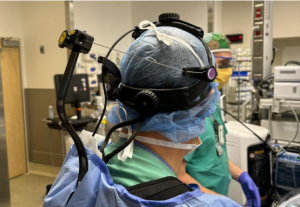
NekSpine addresses cervical fatigue through a different mechanism than positioning adjustments do. Rather than reducing the angle at which the head is held, NekSpine provides a structural path for gravitational force from the head to transfer into the vest worn by the clinician — bypassing the cervical musculature and vertebrae that would otherwise carry that load alone. The neck muscles continue to function; NekSpine does not brace or immobilize the cervical spine. But the ongoing demand on those muscles to stabilize against gravity is reduced because the device structure shares that load.
The difference is the distinction between optimizing conditions and directly addressing the mechanism. Ergonomic positioning optimizes the conditions under which cervical load accumulates. NekSpine reduces the rate of accumulation directly, during the procedure, without requiring the clinician to stop or reposition. The two approaches address different parts of the same problem, which is why they work better together than either does alone. Clinicians interested in how NekSpine fits into the full ergonomic picture can read the detailed resource on how NekSpine supports invasive surgeries.
Why Static Load Builds Over Time
Static muscular effort — holding a position rather than moving through it — is more fatiguing than dynamic effort at the same force level. Surgical and dental postures require static stabilization: the clinician holds the head at a consistent angle for the duration of a procedure, with movement constrained by the need to maintain visual focus on the operative field. This static demand is the primary driver of cervical fatigue in clinical work. Ergonomic positioning reduces the force level of that static demand. It does not convert static effort to dynamic effort or allow the muscles to cycle through contraction and relaxation. The muscles stabilize continuously and fatigue continuously, no matter how well the starting position is optimized.
Understanding this distinction helps clarify why clinicians who follow ergonomic recommendations conscientiously still experience neck and back pain. They manage a real risk effectively but don’t eliminate it. The risk is load under static stabilization sustained over time — and that risk exists at every angle, optimized or not. The clinical evidence supporting NekSpine includes independent research measuring EMG-assessed reductions in neck muscle strain during NekSpine use across multiple flexion angles, which quantifies the direct load-reduction effect in terms the ergonomic research literature recognizes.
Combining Ergonomics With Active Cervical Support
The most effective approach to long-term cervical health in clinical practice is not ergonomic adjustment OR wearable support — it is both, used together. Ergonomic positioning establishes the best possible starting angle and reduces the load level the cervical spine carries throughout the procedure. NekSpine reduces the portion of that load that would otherwise be carried entirely by the neck’s musculature and vertebral structures. Together, The address cervical fatigue at two distinct points in its accumulation pathway.
Clinicians who have already invested in quality loupes, appropriate stools, and adjustable tables have done the work of optimizing their procedural conditions. Adding NekSpine to that setup addresses the mechanism those investments cannot reach: the gravitational load that continues to act on the cervical spine regardless of the angle it holds. For clinicians who perform multiple consecutive cases — the outpatient and ambulatory surgery environment in particular — the compound benefit across a full day’s schedule is substantially greater than what either approach delivers alone. The NekSpine for outpatient ORs page covers how this combined approach applies in high-volume consecutive-case settings.
What This Means for Long-Term Clinical Practice
Musculoskeletal problems in surgeons and dentists are not primarily acute injuries — they are the endpoint of cumulative strain that builds over years and decades of clinical work. The clinician who manages cervical load well at the beginning of a career takes a different trajectory than one who does not. By the time symptoms become significant enough to affect scheduling, operative capacity, or career longevity, the accumulation that produced them represents years of unaddressed procedural load.
The conversation about ergonomics matters precisely because chronic musculoskeletal injury in surgeons is preventable when addressed early. The limitation is that most of the standard ergonomic conversation addresses setup conditions — and setup conditions, while important, are only part of the picture. Direct cervical support during procedures addresses the part that ergonomic setup cannot. The multi-case surgical endurance support program covers the full fatigue-management picture for clinicians working long or consecutive-case schedules. Clinicians who want to understand how their current ergonomic practice and NekSpine could work together in their specific setting can schedule a consultation through the NekSpine contact page.
Posture fixes are not wrong — they are incomplete. The clinicians who sustain long, high-performance careers are the ones who address the full scope of what causes cervical fatigue, not just the part that adjustable equipment can reach. Direct cervical support during procedures is the missing piece that ergonomic optimization alone cannot provide.