The OR Ergonomics Conversation That Is Not Happening
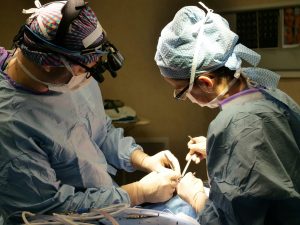
The surgeon who performs a four-hour case accumulates cervical and postural load across that case. The surgical assistant who stands across the table, holding retraction, maintaining exposure, and supporting the operative field for the same duration may accumulate significant static postural load — often without the positional variation that the surgeon’s active operative role occasionally allows. The scrub technician who manages the instrument table throughout the case stands in sustained forward flexion at the scrub table for the full duration. Neither of these roles appears meaningfully in the surgical ergonomics literature, and neither appears meaningfully in the product marketing for ergonomic devices designed for the OR. That gap is worth addressing, both because the occupational health burden on OR support staff is a concern worth addressing and because the institutional case for ergonomic investment in the full OR team follows similar logic to the case for investing in attending surgeons alone. Contact our team through our contact page to discuss how NekSpine applies to your full OR team.
The Postural Profile of the Surgical Assistant During a Case
Why Surgical Assistants May Carry Higher Static Load Than the Attending Surgeon
The attending surgeon moves through the operative field — repositioning relative to the anatomy, changing hand positions, adjusting angle and approach as the case progresses. The surgical assistant’s role is often defined by precisely the opposite movement pattern: maintaining a fixed retraction position, holding exposure steady, and supporting the operative field in a static configuration that the surgeon’s work requires to remain constant. This sustained static posture, often in forward flexion across a deep operative field, means the surgical assistant may accumulate significant cervical and upper extremity load in a profile that does not allow for the brief postural variations that the attending surgeon’s active role occasionally provides. According to Hansraj KK, Surg Technol Int, 2014, forward head tilt of forty-five degrees generates a reported forty-nine pounds of effective load on the cervical spine, and that load applies regardless of whether the person sustaining it is performing the operative procedure or supporting it. According to Epstein et al., JAMA Surgery, 2018, which examined 5,828 physicians across 21 studies, neck and back are among the most prevalent sites of work-related musculoskeletal disorders in the surgical setting — a pattern that the occupational health of OR support staff plausibly mirrors. More on the postural demands of OR roles is available on our hidden cost MSK blog.
The Postural Profile of the Scrub Technician During a Case
Sustained Flexion at the Instrument Table Across a Full Operative Day
The scrub technician manages a complex instrument array throughout the case, maintaining visual access to the sterile field, anticipating instrument needs, and responding to the operative team from a fixed position at the scrub table. The postural demands of this role include sustained forward flexion to maintain visual access to the instrument table and field simultaneously, fine motor precision that requires a steady head and neck position, and the repetition of reaching, handling, and returning instruments across an operative case that may run several hours. Across a full day of multiple cases, the cumulative cervical and postural load on a scrub technician follows a pattern similar to that documented in high-volume surgical practice: repetition across multiple shorter exposures rather than single long cases, with each exposure adding to the daily cumulative load. According to PMC worldwide MSD meta-analysis, 2023, musculoskeletal disorders are among the leading occupational health concerns across the broader healthcare workforce — a pattern that applies to OR support staff as well as surgeons. Contact our team through our contact page to discuss how NekSpine applies to the scrub technician role specifically.
Why the Workforce Implications Extend Beyond Surgeons
OR Technical Staff Attrition Is an Institutional Concern Just as Surgeon Attrition Is
The institutional argument for ergonomic investment in attending surgeons rests on the cost of losing experienced surgical capacity to occupational injury — recruitment, credentialing, onboarding, and the coverage gap during replacement. That same argument applies to the OR technical workforce, where experienced scrub technicians and surgical assistants carry institutional value that is difficult to replace quickly and that may contribute to OR efficiency, case safety, and team cohesion in ways that are not captured by headcount alone. MSD-related attrition in the OR technical workforce affects institutional capacity just as surgeon attrition does, and the investment case for ergonomic support applies to the full team. Hospitals that evaluate NekSpine for a surgical staff ergonomics program should consider whether the evaluation framework includes OR team members beyond attending surgeons, and whether the pilot structure is designed to capture the experience of surgical assistants and scrub technicians alongside the attending surgeon cohort. Our hospital pilot execution kit describes how the pilot evaluation framework can be structured for the full OR team.
How NekSpine Applies to OR Support Staff Roles
A Device Designed for the Postural Profile of Procedural Work, Not Only for Attending Surgeons
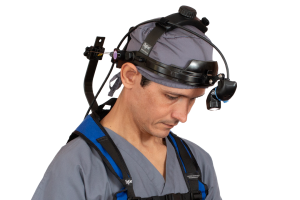
NekSpine addresses the intraoperative forward head flexion load that sustained procedural positioning produces. That load is not specific to the attending surgeon role — it is produced by any individual who sustains forward head flexion under load for an extended period, regardless of their role at the operative table. The device’s mechanical function — counterbalancing the weight of the head through a carbon fiber support beam that transfers load from the head to the hips — operates the same way whether the wearer is performing the operative procedure or supporting it. The University of Alberta / EWI Works, Sensors, 2026 (DOI: 10.3390/s26041354) confirmed that the device effect was maintained across multiple flexion angles during tasks mimicking surgical demands, with reported reductions in both neck and lower-back muscle activity and perceived discomfort. For surgical assistants and scrub technicians whose postural demands closely mirror the attending surgeon’s, the evidence base for the device’s function is directly relevant. Contact our team through our contact page to discuss how NekSpine applies to OR support staff roles and how to include them in a hospital pilot evaluation.
The Ergonomics Conversation in the OR Should Include Everyone at the Table.
The peer-reviewed evidence on surgical postural strain was developed primarily in attending surgeon populations. The biomechanical mechanism it documents — sustained forward head flexion under load producing cumulative cervical and postural strain — applies to anyone who sustains that posture for comparable durations, regardless of their role. Surgical assistants who hold static retraction for hours, and scrub technicians who manage instrument tables throughout long cases, operate in that profile every day. The institutional investment case for ergonomic support in the full OR team follows the same logic as the case for attending surgeons alone, and a pilot evaluation that includes OR support staff produces more complete institutional data than one that covers only the attending surgeon cohort. Contact our team through our contact page to discuss how to structure an evaluation for your full OR team, or review the clinical evidence that supports the device’s function on our clinical evidence page.